
Powerhouse Guardians • Autonomous Security
🤖 Mobile Security Robots
AI-Driven Autonomous Patrol — 24/7, Zero Fatigue, Zero Blind Spots
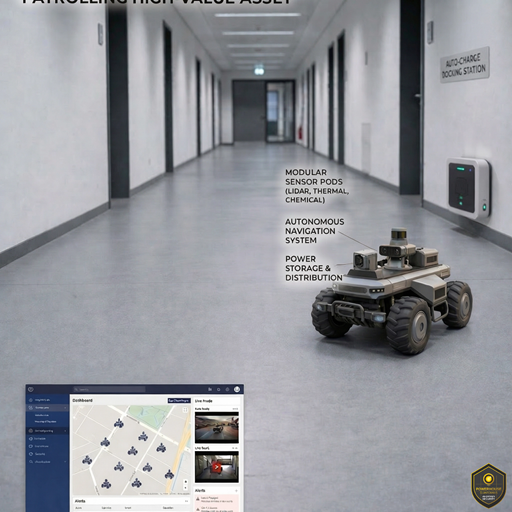
Powerhouse Guardians deploys next-generation autonomous security robots engineered for continuous perimeter patrol, real-time threat detection, and intelligent response — without the operational overhead of stationary cameras or round-the-clock guard staffing. Our robots combine multi-sensor fusion, on-board edge AI, and live command-center integration to deliver a proactive security posture that scales to any environment.
From corporate campuses and distribution warehouses to construction sites and government facilities, our robotic units operate autonomously across indoor and outdoor terrain, self-navigate patrol routes, self-charge at docking stations, and escalate verified threats to human operators in real time.
false alarms
patrol coverage
sensor coverage
• Sick days
to alert dispatch
Core Technology
Built for Intelligence & Autonomous Action
Our robots are not remote-controlled cameras on wheels — they are fully autonomous, AI-driven security platforms that analyze every movement, validate every alert, and act on verified threats without waiting for human input.
Multi-Sensor AI Perception
Every robot integrates a layered sensor suite that delivers a complete environmental picture — day, night, and in adverse weather — with on-board AI processing for instant classification.
- 4K Optical Cameras: High-resolution day/night vision with PTZ auto-tracking on verified targets
- Thermal Imaging: Detects human heat signatures through smoke, fog, and total darkness
- 16-Line LiDAR: 3D spatial mapping for precise object sizing, speed measurement, and navigation
- Chemical Sensors (optional): Modular pod for gas leak and hazardous substance detection
- Two-Way Audio: Remote operators deliver live verbal warnings directly through the robot
Fully Autonomous Operation
Designed for zero-intervention deployment — the robot plans its own patrol routes, avoids obstacles, returns to its docking station to recharge, and resumes patrol automatically.
- SLAM Navigation: Simultaneous Localization and Mapping for dynamic, obstacle-aware routing
- Auto-Charge Docking: Self-returns to charging station when battery is low; resumes patrol on full charge
- Configurable Patrol Routes: Scheduled, randomized, or event-triggered patrol patterns via command center
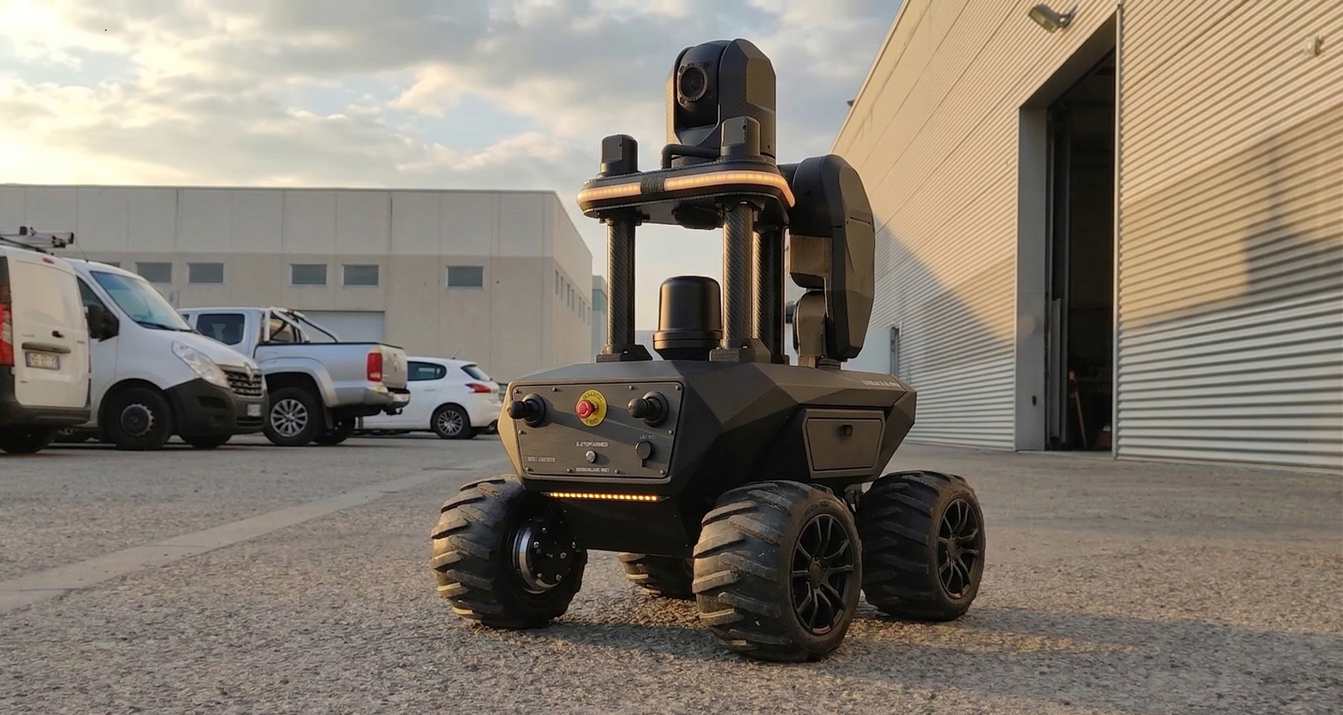
- Indoor & Outdoor Terrain: All-terrain wheels rated for concrete, asphalt, gravel, and grass
- GPS + Cloud VMS Integration: Real-time location tracking and live feed accessible from any device
Intelligent Threat Alerting
The AI does not just detect motion — it classifies, validates, and escalates only verified threats, eliminating the noise that overwhelms traditional security systems.
- Object Classification: Deep learning distinguishes humans, vehicles, and animals with high precision
- Behavioral Analysis: Identifies loitering, erratic movement, and zone intrusions vs. normal activity
- Virtual Tripwires: Configurable perimeter zones trigger immediate alerts on breach
- License Plate Recognition (LPR): Automated vehicle identification and watchlist matching
- Facial Recognition (optional): Biometric identification for access-controlled environments
Command Center Integration
Every robot feeds into a centralized cloud VMS dashboard, enabling remote operators to monitor multiple units simultaneously, review incident footage, and dispatch response teams with a single click.
- Live Multi-Robot Dashboard: Real-time map view of all deployed units with status indicators
- Instant Incident Clips: AI-tagged video clips delivered to operators the moment an alert fires
- Mobile App Control: Full robot management and live feed access from iOS and Android
- API Integrations: Connects to existing access control, alarm, and dispatch systems
- Audit Trail & Reporting: Automated shift reports, incident logs, and compliance documentation
AI Intelligence
Multi-Layered False Alarm Mitigation
The efficacy of autonomous security systems hinges on their ability to differentiate between a persistent threat and environmental “noise.” Traditional motion sensors operate on binary logic. Our AI-driven platform employs four independent validation layers before a single alert reaches a human operator.
Instead of triggering on pixel changes — like a tree moving in the wind — the AI uses deep learning neural networks to identify specific shapes and silhouettes. It can distinguish between a human, a vehicle, and animals with high precision, eliminating the false positives that plague legacy motion-detection systems.
Industry benchmarks from AI-integrated platforms have demonstrated a reduction in false positives of up to 99% compared to traditional infrared or pixel-change sensors. This means your command center receives alerts that matter, not noise that wastes response resources.
Unlike infrared beams that detect along a single line, the robot’s 16-line LiDAR sensor monitors across a full 3D surface. This allows the system to set configurable parameters for object size, height, and speed — essentially “ignoring” anything that doesn’t match the physical profile of a person or vehicle.
A blowing plastic bag, a small animal, or windswept foliage will not match the volumetric signature of a human intruder. The LiDAR layer acts as a physical reality check that the optical AI must agree with before an alert escalates.
The software doesn’t just see a person — it analyzes movement patterns over time. It can differentiate between a worker walking a routine path and someone loitering near a restricted zone, moving erratically, or repeatedly approaching and retreating from a perimeter boundary.
Behavioral flags include: loitering beyond a configurable time threshold, direction reversals near access points, crouching or crawling postures, and velocity anomalies that suggest evasive movement. Only behaviors that match threat profiles trigger escalation to human operators.
Modern AI learns the “baseline” of its environment over time. On a particularly windy day, the AI model automatically adjusts its sensitivity thresholds in real time to compensate for moving foliage or blowing debris. In rain or fog, the thermal sensor takes precedence over optical classification.
This dynamic calibration means the system becomes more accurate over time, not less. It builds a statistical model of what “normal” looks like at your specific site — and flags only deviations from that baseline as potential threats.
All four validation layers run on on-board edge processors — not in the cloud. By analyzing sensor data locally on the robot, the system makes split-second decisions to dismiss false alarms (like a stray cat triggering the optical sensor) without ever burdening the command center. Verified threats are then transmitted with full context: video clip, LiDAR map, behavioral flag, and GPS coordinates. This architecture delivers sub-2-second alert latency while keeping bandwidth consumption minimal.
Technology Comparison
Traditional Security vs. AI Autonomous Robots
A direct comparison of legacy security approaches against the autonomous robotic platform — across the dimensions that matter most to operations managers and security directors.
| Feature / Dimension | Traditional Motion Sensors | Human Guard (Static Post) | AI Autonomous Robot |
|---|---|---|---|
| Detection Logic | Simple pixel or thermal change | Human observation (variable) | Neural network object recognition |
| False Alarm Rate | ✗ Up to 98% false alarm rate | ~ Moderate (fatigue-dependent) | ✓ Up to 99% reduction in false alarms |
| Triggers | Shadows, wind, animals, insects | Whatever is visible from post | Verified human / vehicle presence only |
| Coverage Area | Fixed field of view | Limited to patrol route | Full perimeter, autonomous routing |
| Night / Low-Light | ~ Infrared only | ✗ Severely degraded | ✓ Thermal + optical fusion |
| Response to Threat | Blind alarm activation | Physical intervention (risk to guard) | Intelligent PTZ lock-on + live talk-down |
| Behavioral Analysis | ✗ None | ~ Subjective | ✓ Loitering, erratic movement, zone breach |
| Environmental Adaptation | ✗ Static thresholds | ~ Manual adjustment | ✓ Real-time AI sensitivity calibration |
| Operational Continuity | Always on (passive) | Shift-limited, fatigue-affected | 24/7 autonomous, self-charging |
| Scalability | Requires re-wiring / re-installation | Linear cost increase per guard | Add units; no infrastructure changes |
| Incident Documentation | Passive recording only | Manual report writing | AI-tagged clips, GPS log, automated report |
| Compliance & Audit Trail | ~ Basic footage archive | ✗ Paper-based | ✓ Full digital chain of custody |

Deployment Options
Choose Your Robotic Security Configuration
Three purpose-built deployment tiers cover every operational scenario — from short-term construction site coverage to permanent enterprise campus security. All tiers include professional deployment, configuration, and ongoing monitoring support.
- 1 autonomous patrol robot
- 4K optical + thermal cameras
- 16-line LiDAR navigation
- Auto-charge docking station
- Cloud VMS dashboard access
- Mobile app monitoring
- AI object classification
- Ideal for: construction sites, temporary events, single-building perimeters
- 2–4 coordinated patrol robots
- Full sensor suite per unit (optical, thermal, LiDAR)
- Behavioral analysis & loitering detection
- License Plate Recognition (LPR)
- Two-way audio talk-down capability
- 24/7 remote monitoring integration
- Automated incident reporting
- Ideal for: warehouses, distribution centers, corporate campuses, parking structures
- 5+ robot fleet with zone-based routing
- Modular chemical / gas sensor pods
- Facial recognition integration
- Access control system API integration
- Dedicated command center dashboard
- SLA-backed response time guarantees
- Quarterly AI model retraining for site baseline
- Ideal for: government facilities, critical infrastructure, large industrial complexes, multi-building campuses
Technical Specifications
Robot Hardware & Performance Specs
Enterprise-grade hardware engineered for continuous autonomous operation across diverse environments and weather conditions.
Operational Advantage
Why Autonomous Robots Outperform Legacy Security
The business case for autonomous robotic security is built on verifiable operational metrics — not marketing claims. Here is what our clients consistently report after deployment.
Robotic patrol units typically deliver a 40–60% reduction in total security operating costs versus equivalent human guard coverage, with zero overtime, no benefits overhead, and no turnover costs.
Autonomous routing ensures every square foot of your perimeter is covered on a defined schedule. No guard fatigue, no distraction, no “I didn’t see it” incidents. Every patrol is logged and timestamped.
Edge AI processes sensor data on-board, delivering verified threat alerts to your command center in under 2 seconds — faster than any human operator monitoring a wall of screens can react.
Every incident is automatically documented with 4K video, GPS coordinates, timestamp, AI classification data, and a full chain of custody log — ready for law enforcement or legal proceedings.
No trenching, no wiring, no construction permits. A robotic unit can be operational on your site within hours of arrival — ideal for construction sites, pop-up events, or emergency security gaps.
Add units to expand coverage, redeploy to new sites instantly, or scale back during low-risk periods. Your security footprint flexes with your operational needs — not a fixed headcount.
Industries Served
Deployed Across High-Risk Environments
Our autonomous security robots are purpose-configured for the specific threat profiles, compliance requirements, and operational constraints of each industry vertical.
After-hours perimeter patrol, dock monitoring, and cargo theft deterrence for high-value inventory environments.
Multi-building patrol coordination, parking structure monitoring, and employee safety escorts after hours.
Equipment theft prevention, unauthorized access detection, and after-hours perimeter security with rapid deployment.
Compliance-grade security with full audit trails, access control integration, and classified zone monitoring.
Parking lot patrol, loss prevention support, and customer safety in high-traffic commercial environments.
Utility substations, data centers, and industrial plants requiring 24/7 perimeter integrity and chemical hazard detection.
HOA and multi-family community patrol, visitor monitoring, and amenity area security during off-hours.
Rapid-deployment crowd monitoring, perimeter control, and post-event security sweeps for temporary high-occupancy environments.
Ready to Deploy Autonomous Security?
Schedule a no-obligation site assessment with our robotic security specialists. We will evaluate your perimeter, identify coverage gaps, and design a deployment configuration sized to your threat profile and budget.
Powerhouse Guardians Corp. • TX License #B30802201 • SBE Certified • Insured & Bonded • 25+ Years Experience • Dallas-Fort Worth Metroplex, TX